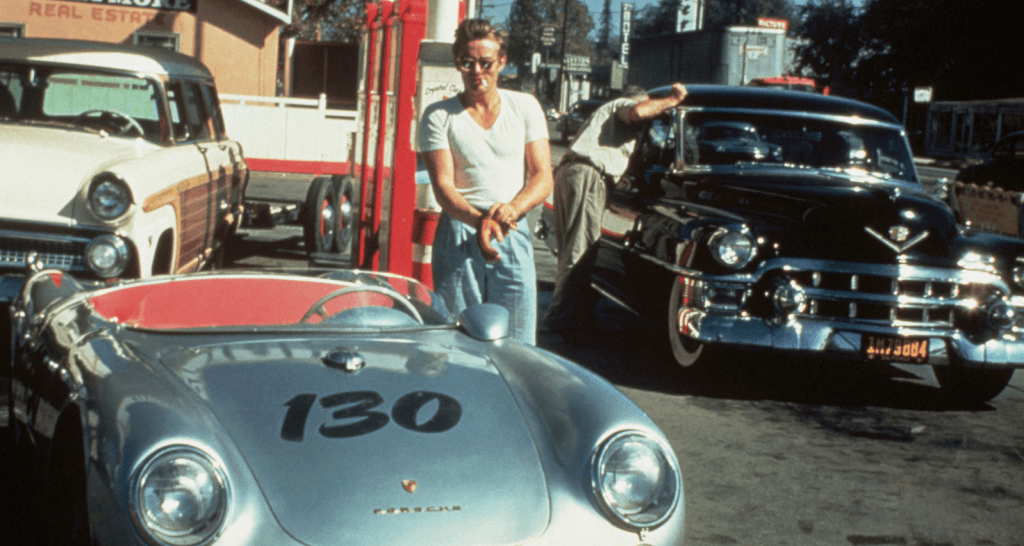
James Dean’s cursed Porsche.
Czytaj dalej →
04.08.2025
The Tesla company is named after Serbian inventor and engineer Nikola Tesla, who, as a pioneer in the fields of electricity and electromagnetism, contributed to the development of alternating current technology. Tesla’s founders thus wanted to pay tribute to his innovations and continue his legacy in modern electric mobility.

Tesla Motors was founded in July 2003 as a U.S. company by Martin Eberhard and Marc Tarpenning, who wanted to create an electric car that combined efficiency and range previously unseen in the market. In its first year of operation, the founders focused on raising capital – Elon Musk played an important role, investing $6.3 million in a Series A funding round and becoming chairman of the board. This funding allowed the company to partner with Lotus Cars, which provided the chassis for the Roadster prototype. At the same time, Tesla engineers worked on adapting the induction motor and battery management system, a key innovation that set the brand apart from other electric vehicle manufacturers.
Fascinated by the history of the electric revolution with Tesla? Check out Tesla Rental and experience the technology of the future today.
March 2008 saw the unveiling of the Tesla Roadster, a pure electric drive technology encapsulated in a car silhouette similar to a sports roadster. Based on a lightweight body from Lotus Cars, with a single engine and a top speed in excess of 200 km/h, the Roadster proved that an electric car could compete with traditional sports cars, generating enthusiasm from the automotive media and customers, while opening a new chapter in the development of electromobility.

In June 2010, Tesla Inc went public on the NASDAQ New York Stock Exchange and became one of America’s best-known companies. It raised $226 million, which allowed it to acquire the NUMMI factory in Fremont and invest in the development of the Model S – an electric sedan with a range of more than 400 kilometers, a liftback interior and luxury trim. In 2015, it added the Model X, a crossover with “falcon wing” doors, a seven-seat interior and advanced safety systems.
In 2016, Tesla acquired SolarCity, creating the Tesla Energy division, which focuses on photovoltaic solutions and energy storage. During the same period, the company changed its name to Tesla, Inc. signaling an expansion of its business beyond automobiles. A key project became the Model 3, a more affordable electric car offering autonomous driving in a basic package, whose production encountered difficulties Musk called “production hell.” Despite the delays, the Model 3 became the world’s best-selling electric vehicle already in 2018, confirming the right choice of a mass-market segment strategy.

Starting in 2019, Tesla intensively expanded its presence in international markets, opening sales locations and factories in South Korea, Berlin, Shanghai and Texas. The Model Y, a compact SUV with the option of three rows of seats, and the futuristic Cybertruck with a steel body were added to the portfolio. At the same time, the company continued work on another Roadster, delivering even better performance and range.
Tesla’s first production model, unveiled in 2008. Based on the Lotus Elise chassis, the Roadster achieved 0-100 km/h acceleration in less than 4 seconds and a range of more than 340 km on a single charge. It used an advanced lithium-ion battery management system, a breakthrough in safety and battery performance. Its car silhouette similar to a classic roadster and carbon-fiber body emphasized the vehicle’s sporty character and top speed.
Introduced in 2012, the luxury electric sedan featured sleek styling, a fully digital dashboard and a range of more than 400 kilometers. The Model S was also Tesla’s first production car with a single engine as standard, as well as a 17″ touchscreen and a basic version of the Autopilot system for autonomous driving.

Debuting in 2015 was a crossover SUV with unique “falcon wing” doors. The Model X offered a spacious seven-seat interior and two Dual Motor engines for impressive propulsion and acceleration, putting it at the forefront of the automotive market.

Introduced in 2017 as a mass-market car, the Tesla Model 3 has become the world’s best-selling electric car. It features a simple car silhouette, a range of 350 to 560 kilometers and acceleration to 100 km/h in 3.3 seconds in the top Performance variant. This liftback with a modern design proves the effectiveness of pure electric drive technology.
Introduced in 2020, a compact SUV based on the Model 3 architecture, the Model Y offers optional third-row seating and various powertrain configurations, including all-wheel drive. With production in South Korea and the United States, it has become available in many markets, including Poland.

Unveiled in 2019 is a futuristic pickup truck with a stainless steel body. Cybertruck is distinguished by its unique design, robust construction realized by electric motors and the option of autonomous driving in the plans. Its car was created to cope with heavy loads, combining durability with innovative solutions.

The Tesla Semi truck, revealed in 2017, is designed to transport goods over long distances. Equipped with four electric motors and an advanced induction motor, it offers a range of up to 800 kilometers and significantly lower operating costs compared to diesels. This vehicle is set to change the face of trucking.

Announced in 2017 as a follow-up to the original Roadster, the second Roadster is expected to be the world’s fastest production car, with 0-100 km/h acceleration in 1.9 seconds and a range of up to 1,000 km. The company plans to use Tesla’s technology strategy focuses on innovation in the 4680 cell to achieve higher performance.
Tesla’s breakthrough is the Autopilot system, which offers advanced driver assistance with adaptive full autonomy (FSD). Tesla is also developing its own battery cells – the 4680 format – for higher energy density and faster charging. The company is investing in a network of Superchargers, enabling charging with up to 250 kW of power, which significantly eliminates the range limitation. A unique approach is vertical integration – Tesla controls the design, manufacturing and sales process, minimizing dependence on subcontractors and accelerating innovation. Tesla’s technology strategy is to further develop autonomous solutions and optimize cells.
As a US company, Tesla Inc sells vehicles directly through its own showrooms and online store, bypassing the traditional dealer system. Tesla’s logo adorns displays and is a globally recognized element. The company operates in the United States and is expanding to overseas markets, including South Korea and Europe, building a network of dealership locations.
Elon Musk, visionary and CEO of the Tesla brand, uses social media, including Twitter, to communicate his vision and inspire his community. His approach is attracting the attention of investors and a cadre of professionals, and the brand is succeeding in the global automotive market. Musk is not afraid of controversy or risk, which fuels the company’s growth and strengthens its position.
Tesla’s activities have accelerated the development of electromobility – as a result, other manufacturers have shortened the time to introduce electric cars to their offerings, including the Tesla Model S, Model X and Model Y, which have become a model for competitors. The increase in production of zero-emission vehicles has affected battery prices, making the technology more accessible to a wide audience. At the same time, energy storage projects such as Powerwall and Megapack are supporting the stabilization of electric grids and the transition to renewable energy sources within the US, as well as in other regions of the world.
In the coming years, key areas will be the development of autonomous driving, mass production of 4680 cells and entry into new segments – micromobility, public transportation and large-scale energy storage. Challenges include increasing competition, autonomy regulations and raw material issues related to lithium and cobalt extraction. The long-term strategy remains to make Tesla an integral part of the global energy system, providing solutions that combine transportation, storage and energy production.
Tesla’s history dates back to 2003, when the company was founded as Tesla Motors, and the first car was a roadster model based on the Lotus Elise body.
The Tesla Model S, introduced in 2012, defined the segment with a powerful electric sedan with a range of more than 400 kilometers.
The Tesla Model X is a crossover with “falcon wing” doors, offering a spacious interior and an excellent dual-motor drive.
The Tesla Model Y combines features of an SUV and a sedan, offering a third-row seating option and powerful all-wheel drive.
The Tesla Cybertruck has a futuristic look and steel body, and its power and durability make it unique in the pickup market.
The Tesla Model 3 is the most affordable model and has become the world’s best-selling electric car.
The phrase “Tesla model” refers to the line of vehicles produced by Tesla brands, with different power and range configurations.
The company was founded in Silicon Valley, but also has its main offices in New York, where it coordinates marketing activities.
Elon Musk, as CEO, drives the company’s strategy and decides the direction of the technology.
FSD stands for Full Self-Driving, and the manufacturer’s vehicles offer various power levels, reaching up to 1020 hp in the Performance version.
The name Tesla does not refer to nationality – Nikola Tesla was a Serb, and Tesla Motors was founded in the United States.
Nikola Tesla invented, among other things, the induction motor and the alternating current transmission system, which became the foundation of modern power grids.
Tesla’s first car was the 2008 Roadster, based on a Lotus Elise chassis and using pure electric propulsion technology.
Tesla is not only electromobility, but also exceptional acceleration and modern design. Rent a model from our fleet and see the future of driving for yourself.
View Tesla rental offerings